
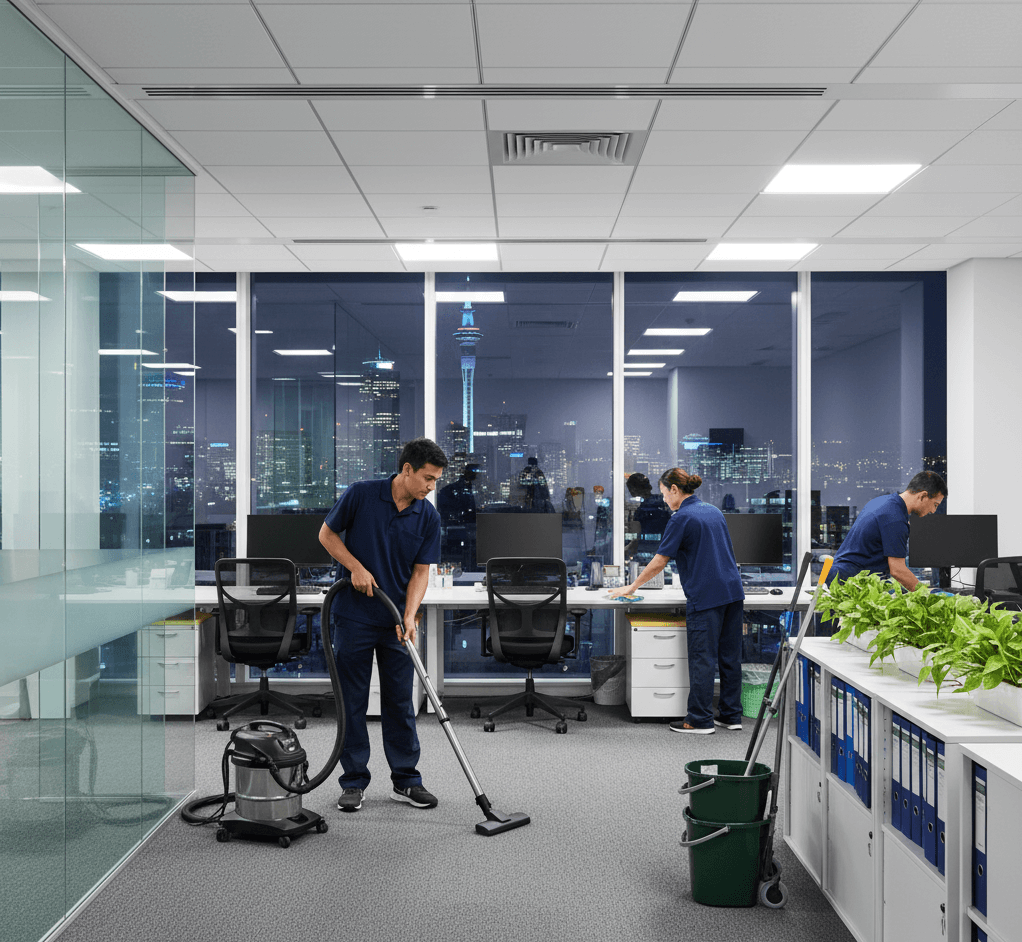
Office cleaning services in Auckland include daily janitorial maintenance, deep cleaning, carpet and floor care, window cleaning, sanitization, and specialized services for CBD high-rises and suburban business parks.
Professional cleaners work flexible schedules including after-hours service to maintain Auckland’s diverse commercial spaces from small professional offices to large corporate headquarters.
Table of Contents
- What’s included in standard office cleaning in Auckland?
- How much does office cleaning cost in Auckland?
- Why do Auckland businesses need professional office cleaning?
- How often should Auckland offices be professionally cleaned?
- What makes Auckland office cleaning different from other regions?
- Do office cleaners work after hours in Auckland?
- How do you choose a reliable office cleaning company in Auckland?
- What cleaning standards apply to Auckland office buildings?
- Can office cleaning improve employee productivity and reduce sick leave?
What’s included in standard office cleaning in Auckland?
Professional office cleaning services in Auckland encompass comprehensive maintenance designed to keep business environments hygienic, professional, and productive.
Daily cleaning tasks form the foundation of most office cleaning contracts:
Reception and common areas:
- Vacuuming all carpeted floors and floor mats
- Mopping hard floors with appropriate cleaners
- Dusting and wiping reception desks, countertops, and surfaces
- Cleaning glass doors and windows at entry points
- Emptying all rubbish bins and replacing liners
- Spot-cleaning walls and removing marks or scuffs
Individual offices and workstations:
- Vacuuming carpets and floor areas
- Wiping down desks, tables, and work surfaces
- Dusting computer monitors, keyboards, and equipment (exterior only)
- Emptying desk-side bins
- Straightening chairs and general tidying
Kitchen and breakroom facilities:
- Cleaning sinks, benchtops, and splashbacks
- Wiping down tables and chairs
- Cleaning microwave interiors and exteriors
- Emptying rubbish and recycling bins
- Mopping floors
- Wiping down appliance exteriors (fridges, dishwashers)
- Restocking paper towels and hand soap
Bathroom facilities:
- Cleaning and sanitizing toilets, urinals, and bidets
- Cleaning sinks, taps, and mirrors
- Mopping floors with disinfectant
- Restocking toilet paper, hand soap, and paper towels
- Emptying sanitary bins
- Wiping down partitions and doors
- Cleaning fixtures and fittings
Corridors and circulation spaces:
- Vacuuming or mopping all floor surfaces
- Spot-cleaning walls and doors
- Dusting handrails and fixtures
- Ensuring fire exit routes remain clear and clean
Weekly or periodic services supplement daily cleaning:
Deep cleaning tasks:
- Detailed dusting of shelves, windowsills, and picture frames
- Cleaning interior windows thoroughly
- Vacuuming upholstered furniture
- Cleaning light switches, door handles, and high-touch surfaces with disinfectant
- Detailed kitchen appliance cleaning
- Cleaning under desks and furniture
- Dusting ceiling vents and air conditioning units (low-level)
Monthly or quarterly services:
- Carpet deep cleaning and extraction
- Hard floor stripping, sealing, and polishing
- Window cleaning including exterior windows
- High-level dusting (ceiling fans, light fixtures, air vents)
- Blind and curtain cleaning
- Upholstery deep cleaning
Specialized Auckland office services:
CBD high-rise cleaning requires specific expertise for:
- Multiple-floor coordination with building management
- Elevator and stairwell maintenance
- High-security environments
- After-hours access protocols
- Water-fed pole systems for external windows
Business park and suburban offices need:
- Car park and entrance cleaning
- External areas and courtyards
- Reception area presentation focus
- Flexible scheduling around varied business hours
COVID-19 and sanitization protocols remain important:
- Enhanced disinfection of high-touch surfaces
- Touchpoint cleaning throughout the day
- Sanitization of shared equipment
- Air quality considerations
Auckland’s commercial cleaning services customize packages based on your office size, industry requirements, staff numbers, and specific needs rather than offering one-size-fits-all solutions.
How much does office cleaning cost in Auckland?
Office cleaning costs in Auckland vary based on office size, frequency, service scope, and location within the greater Auckland region. Understanding typical pricing helps businesses budget appropriately.
| Pricing Factor | Impact on Cost |
| Office size (square metres) | Larger spaces cost more; economies of scale apply |
| Cleaning frequency | Daily contracts offer better per-clean rates than weekly |
| Service scope | Basic cleaning vs. deep cleaning vs. specialized services |
| Location within Auckland | CBD premiums vs. suburban rates; parking costs |
| Building type | High-rise complexity vs. ground-floor accessibility |
| After-hours requirements | Evening/night/weekend cleaning may include premiums |
| Staff numbers | More employees = more mess requiring more time |
Small office cleaning costs (50-100 square metres):
- Daily cleaning: $80-$150 per clean
- 2-3 times weekly: $100-$180 per clean
- Weekly cleaning: $120-$200 per clean
- Monthly cost (daily service): $1,600-$3,000
These smaller offices typically include 5-15 employees in professional services, startups, or specialized firms common throughout Auckland’s suburban business areas.
Medium office cleaning costs (100-300 square metres):
- Daily cleaning: $150-$350 per clean
- 2-3 times weekly: $180-$400 per clean
- Weekly cleaning: $200-$450 per clean
- Monthly cost (daily service): $3,000-$7,000
Medium offices accommodate 20-50 employees and represent the most common Auckland office size across North Shore, central suburbs, and business parks.
Large office cleaning costs (300-1000+ square metres):
- Daily cleaning: $350-$1,000+ per clean
- Per square metre: $1.00-$2.50 per sqm depending on frequency and scope
- Monthly cost (daily service): $7,000-$20,000+
Large offices in Auckland’s CBD, particularly those in high-rise buildings like the ANZ Centre, PwC Tower, or Vero Centre, require specialized cleaning teams and coordination with building management.
Additional service costs:
- Carpet cleaning: $3-$6 per square metre
- Window cleaning (interior): $5-$10 per window
- Window cleaning (exterior high-rise): $8-$20 per window depending on height and access
- Hard floor maintenance: $4-$8 per square metre for stripping and sealing
- Deep cleaning: 50-100% premium over standard rates
- One-off or spring cleaning: $500-$2,000+ depending on office size
Auckland-specific cost factors:
CBD location premiums: Central city offices often pay 10-20% more than suburban locations due to:
- Parking costs and access difficulties
- Building security and management requirements
- Higher operating costs for service providers
- After-hours building access fees
North Shore, West Auckland, South Auckland variations: Offices in Takapuna, Henderson, Albany, or Manukau may see slightly lower rates than CBD but higher than rural areas.
Building management requirements: Some Auckland commercial buildings require cleaning companies to use specific products, maintain certain insurance levels, or coordinate through building management, affecting costs.
Contract vs. one-off pricing: Long-term contracts (6-12 months) typically offer 15-25% better rates than casual or one-off cleaning services.
Most reputable Auckland office cleaners provide free on-site assessments and customized quotes rather than phone estimates. They assess your specific space, cleaning requirements, access arrangements, and any unique challenges before providing accurate pricing.
Busy Bees Auckland office cleaning services provide transparent quotes based on your office’s specific needs, location, and frequency requirements throughout greater Auckland.
Why do Auckland businesses need professional office cleaning?
Auckland businesses face unique challenges making professional office cleaning essential rather than optional for success and compliance.
First impressions matter in Auckland’s competitive market. As New Zealand’s largest business centre, Auckland hosts countless client meetings, business development opportunities, and professional interactions daily. Clean offices signal competence, attention to detail, and respect for clients and employees. Conversely, dirty or unkempt offices create negative impressions that damage business relationships and opportunities.
Professional services firms, financial advisors, legal practices, and real estate agencies throughout Auckland’s CBD, North Shore, and suburban business districts rely on pristine offices to maintain their professional reputations.
Health and safety compliance isn’t optional. The Health and Safety at Work Act 2015 requires employers to provide safe, healthy work environments. This explicitly includes:
- Clean, hygienic bathroom facilities
- Sanitary kitchen and food preparation areas
- Regular removal of waste and hazardous materials
- Clean floors preventing slip and trip hazards
- Adequate ventilation and air quality
WorkSafe New Zealand can prosecute businesses failing to maintain adequate workplace cleanliness. Professional cleaning provides documented evidence of compliance, protecting businesses from liability.
Employee wellbeing and productivity improve dramatically in clean environments. Research consistently shows that workplace cleanliness directly impacts:
- Sick leave rates (20-30% reduction with proper cleaning)
- Employee morale and job satisfaction
- Focus and concentration
- Stress levels
- Staff retention
Auckland’s tight labour market makes employee satisfaction critical. The cost of replacing staff far exceeds investment in professional cleaning that keeps employees healthy and satisfied.
Reduced illness transmission matters significantly in open-plan offices common throughout Auckland. Viruses and bacteria spread rapidly when high-touch surfaces (door handles, light switches, shared equipment, kitchen facilities) aren’t properly sanitized. During winter months when cold and flu viruses circulate, inadequate cleaning causes cascading sick leave as illness spreads through teams.
Auckland’s unique environmental factors create specific cleaning challenges:
Humidity and mold risk: Auckland’s subtropical climate creates high humidity, particularly in poorly ventilated office buildings. This encourages mold and mildew growth in bathrooms, kitchens, and damp corners. Professional cleaners understand these risks and use appropriate products to prevent mold.
Urban pollution: Auckland’s traffic congestion and urban environment mean dust and particulate matter constantly enter offices through windows, ventilation systems, and foot traffic. Regular professional cleaning removes these pollutants improving air quality.
Volcanic soil: Auckland’s unique volcanic landscape means fine dust particles tracked into buildings require specialized cleaning techniques to prevent embedding in carpets and damaging floor surfaces.
Coastal environment: Businesses near Auckland’s harbours and coastline face salt air and moisture requiring specific maintenance approaches to prevent corrosion and damage.
Asset protection and longevity: Auckland’s commercial property values make protecting assets financially critical. Professional cleaning extends the life of:
- Carpets and flooring (potentially doubling lifespan)
- Furniture and fixtures
- Computer equipment and electronics
- Paint and wall surfaces
- Windows and glass features
Regular commercial cleaning prevents premature replacement of these expensive assets, saving Auckland businesses substantial capital costs over time.
Regulatory and industry requirements: Certain Auckland industries face additional cleaning standards:
- Healthcare facilities must meet Ministry of Health infection control standards
- Food-related businesses require Food Act 2014 compliance
- Childcare and education spaces need child-safe cleaning approaches
- Financial services may require security-vetted cleaners
Professional cleaning companies understand and maintain these industry-specific requirements, ensuring compliance without business owners navigating complex regulations.
How often should Auckland offices be professionally cleaned?
Cleaning frequency for Auckland offices depends on several factors including staff numbers, office type, foot traffic, and industry requirements.
Daily professional cleaning suits:
Large offices (50+ employees):
- Auckland CBD corporate offices
- Call centres and open-plan workspaces
- Client-facing professional services
- Healthcare and medical offices
- Government and public sector offices
These high-occupancy environments accumulate significant mess daily. Bathrooms, kitchens, and common areas require daily attention to maintain hygiene standards and professional appearance.
High-traffic retail or showroom offices in areas like Newmarket, Sylvia Park, or Queen Street need daily cleaning due to constant customer interaction and foot traffic bringing external dirt and debris.
2-3 times weekly cleaning works for:
Medium offices (15-50 employees):
- Professional services firms
- Tech companies and startups
- Administrative offices
- Small corporate branches
These offices generate moderate mess but don’t require daily full cleaning. High-touch surfaces and bathrooms may need daily spot-checks while comprehensive cleaning occurs 2-3 times weekly.
Weekly professional cleaning suits:
Small offices (5-15 employees):
- Boutique professional services
- Home offices or co-working spaces
- Low-traffic administrative offices
- Storage facilities with minimal office component
Weekly cleaning maintains acceptable standards when staff maintain basic tidiness between professional services.
Auckland-specific frequency considerations:
CBD offices often require more frequent cleaning due to:
- Higher foot traffic from external visitors
- More formal professional standards
- Building management expectations
- Greater urban dust and pollution
Business park offices in Albany, East Tāmaki, or Manukau might manage with less frequent cleaning if:
- Lower daily foot traffic
- Primarily internal staff rather than client visits
- Newer buildings with better air filtration
- Smaller teams with lighter cleaning needs
Seasonal adjustments matter in Auckland:
Winter months (May-September): Increase cleaning frequency during Auckland’s wetter months when:
- Mud and moisture tracked indoors increases dramatically
- Cold and flu season requires enhanced sanitization
- Reduced natural ventilation means indoor air quality deteriorates
Summer months (December-March): May allow slightly reduced frequency as:
- Better natural ventilation through open windows
- Less moisture and mud tracking
- Holiday periods mean reduced office occupancy
Industry-specific Auckland requirements:
Healthcare and medical offices require daily cleaning minimum with multiple touchpoint sanitization throughout days.
Food-related businesses need daily cleaning to meet Food Act compliance and maintain health department standards.
Professional services (legal, accounting, real estate) typically need daily or 2-3 times weekly cleaning to maintain client-facing presentation standards.
Tech companies and startups often manage with 2-3 times weekly unless high headcounts demand daily service.
Complementary services schedule:
Beyond regular cleaning frequency, Auckland offices benefit from:
- Carpet deep cleaning: Quarterly for high-traffic areas, annually for low-traffic
- Window cleaning: Quarterly for ground floor, 2-4 times yearly for high-rise
- Hard floor maintenance: Annually or bi-annually for strip and seal
- Deep cleaning: Semi-annually for comprehensive sanitization
Cost-benefit analysis for Auckland offices:
Consider a 30-person office paying:
- Weekly cleaning: $200/clean = $10,400 annually
- 3x weekly cleaning: $180/clean = $28,080 annually
- Daily cleaning: $150/clean = $39,000 annually
The additional $10,000-28,000 investment in more frequent cleaning typically returns through:
- Reduced sick leave costs
- Improved productivity
- Better client impressions
- Extended asset life
- Enhanced employee satisfaction
For most Auckland offices, the appropriate frequency balances budget constraints with cleanliness standards that support business success. Busy Bees Auckland teams help businesses assess their specific needs and recommend optimal cleaning schedules.
What makes Auckland office cleaning different from other regions?
Auckland’s unique characteristics create specific office cleaning requirements distinct from other New Zealand cities or rural areas.
Building diversity and complexity:
CBD high-rise buildings like Commercial Bay, ANZ Centre, and PwC Tower require specialized cleaning approaches:
- Multi-floor coordination with building management
- Security protocols and after-hours access systems
- Elevator scheduling to avoid peak periods
- High-level window cleaning requiring specialized equipment
- Shared facility cleaning (lobbies, elevators, bathrooms)
- Waste management through building systems
Auckland’s vertical CBD creates cleaning challenges absent in single-story suburban offices or regional city offices in Hamilton, Wellington, or Christchurch.
Suburban business parks across Auckland present different challenges:
- Stand-alone buildings with independent access
- Car park and outdoor area maintenance
- Variable building quality and age
- Different security and access arrangements
Building age variations: Auckland’s diverse property stock ranges from heritage buildings in the CBD requiring delicate care to brand-new developments with modern materials and systems. Professional cleaners must understand appropriate techniques for each.
Environmental factors unique to Auckland:
Humidity management: Auckland’s subtropical climate creates humidity challenges uncommon in drier regions. This affects:
- Mold and mildew prevention in bathrooms and poorly ventilated areas
- Carpet drying times after cleaning
- Window condensation and moisture control
- Selection of cleaning products and techniques
Central Otago or Canterbury offices rarely face these humidity issues.
Volcanic dust: Auckland’s volcanic landscape produces fine dust particles that embed in carpets and scratch hard floors if not properly managed. This volcanic dust differs from the sedimentary soils in other New Zealand regions.
Coastal salt air: Offices near Auckland’s harbours, beaches, and coastline face salt air requiring specific approaches to prevent corrosion, window staining, and material damage.
Urban pollution: As New Zealand’s largest city, Auckland’s traffic congestion and urban density create higher levels of airborne particulates, requiring more frequent dusting and air quality management than regional areas.
Labour market considerations:
Higher operating costs: Auckland cleaners face:
- Higher wages reflecting Auckland’s cost of living
- More expensive parking and transport
- Greater competition for quality staff
- Higher insurance and compliance costs
These factors mean Auckland office cleaning typically costs 10-20% more than equivalent services in Hamilton, Wellington, or regional centres.
Diverse workforce: Auckland’s multicultural population provides cleaning companies access to multilingual staff beneficial for diverse business environments but requiring more sophisticated HR and training systems.
Scheduling complexity:
Auckland’s traffic congestion makes scheduling critical. Cleaners must navigate:
- Peak traffic avoiding morning and evening rush hours
- Variable travel times between jobs
- Parking availability and costs in CBD
- Public transport limitations for evening/night work
Regional centres rarely face these logistical challenges affecting service delivery and timing.
CBD parking costs can add $20-50 per visit to cleaning costs, either absorbed by cleaners or passed to clients. Suburban office cleaning avoids these parking expenses.
Regulatory environment:
Building consent requirements: Some Auckland office building modifications or cleaning system changes require Auckland Council consent processes more stringent than regional authorities.
Multiple territorial authorities: Greater Auckland spans Auckland Council, but neighbouring areas may fall under different jurisdictions (Waikato, for example), requiring cleaners serving wider Auckland to understand multiple regulatory frameworks.
Client expectations:
Professional standards: Auckland’s business culture, influenced by international companies and global connectivity, often demands higher standards than regional New Zealand offices. Client-facing businesses particularly expect internationally competitive presentation.
Sustainability focus: Auckland businesses increasingly prioritize environmental credentials, demanding eco-friendly cleaning products and practices. While growing nationally, this trend leads in Auckland.
Technology integration: Auckland offices more commonly feature advanced security systems, building automation, and access controls that cleaners must navigate. Regional offices often have simpler systems.
Despite these Auckland-specific challenges, established cleaning companies like Busy Bees with over 30 years of New Zealand experience understand regional variations and adapt services appropriately. Auckland office cleaning requires local knowledge combined with professional standards to deliver results matching New Zealand’s largest city’s demands.
Do office cleaners work after hours in Auckland?
Yes, the vast majority of Auckland office cleaning occurs outside standard business hours to minimize disruption and allow thorough, efficient cleaning.
Evening cleaning (6pm-11pm) represents the most common schedule for Auckland offices:
Advantages of evening cleaning:
- Offices empty after 5:30-6pm allowing full access
- Cleaners work without navigating around employees
- Equipment, cords, and carts don’t disrupt work
- All areas accessible including meeting rooms and offices
- Parking more available and often free after 6pm in CBD
- Natural light still available early evening
Ideal for:
- Small to medium offices (5-50 employees)
- Suburban business parks
- Professional services offices
- Retail-adjacent offices
Night cleaning (11pm-6am) suits larger operations:
Advantages of night cleaning:
- Complete building access without any staff present
- Coordination with building security and management
- Minimal parking conflicts
- Uninterrupted cleaning time for large spaces
Ideal for:
- CBD high-rise buildings with 100+ tenants
- Large corporate offices (50+ employees)
- Call centres requiring 24-hour operation
- Buildings with sophisticated security systems
Challenges of night cleaning:
- Premium rates (often 10-20% higher)
- Recruitment of night-shift workers
- Building management coordination
- Security and key management
Many Auckland CBD buildings coordinate night cleaning across multiple tenants, with building management overseeing access and schedules.
Weekend cleaning works for specific situations:
Saturday morning cleaning suits:
- Monday-Friday businesses
- Offices needing undisturbed cleaning time
- Deep cleaning or special projects
- Small offices with flexible schedules
Challenges:
- Premium weekend rates
- Limited weekend cleaner availability
- Building access if security-controlled
Daytime cleaning occurs in:
Healthcare facilities: Medical centres, dental practices, and clinics require continuous cleaning during operating hours to manage patient areas, waiting rooms, and treatment spaces.
Large corporate offices: Some Auckland corporate headquarters employ dedicated daytime cleaners who maintain high-traffic areas, restock bathrooms, and handle immediate cleaning needs throughout business hours, supplemented by comprehensive after-hours cleaning.
Retail showrooms: Businesses with retail components need real-time maintenance during operating hours.
Access and security arrangements:
Auckland office cleaners typically manage access through:
Key holding: Trusted cleaners receive office keys with documented key management systems and appropriate security protocols.
Building access cards: High-rise buildings issue access cards programmed for specific times and areas.
Alarm systems: Cleaners receive alarm codes with sign-in/sign-out requirements creating audit trails.
Security coordination: CBD buildings often require cleaners to check in with security guards, maintaining logs of entry and exit times.
Lockup responsibilities: Evening and night cleaners typically lock offices and set alarms after completing work, requiring trustworthy, trained staff.
Scheduling flexibility:
Professional Auckland office cleaners accommodate varied requirements:
- Different start times for different offices
- Schedule adjustments for special events or meetings
- Emergency cleaning outside regular schedules
- Flexibility for client working patterns
Auckland-specific scheduling considerations:
Transport limitations: Public transport reduces significantly after 7pm in many Auckland areas, affecting cleaner availability for very late shifts.
Traffic avoidance: Cleaners schedule to avoid peak traffic, typically arriving at CBD offices after 7pm when congestion clears.
Multi-site coordination: Companies cleaning multiple Auckland offices schedule routes efficiently, considering traffic patterns and parking availability across locations.
Building management requirements: Many CBD buildings mandate specific cleaning windows coordinated across all tenants, limiting flexibility but ensuring building-wide efficiency.
For businesses concerned about security, reputable cleaning companies like Busy Bees provide:
- Police-vetted staff
- Comprehensive insurance coverage
- Documented security procedures
- Regular supervision and quality checks
- Clear protocols for key management and access
After-hours cleaning has become standard practice across Auckland’s business community, balancing operational needs with security considerations and professional cleaning requirements.
How do you choose a reliable office cleaning company in Auckland?
Selecting the right office cleaning company significantly impacts your business operations, costs, and workplace environment. Auckland’s competitive market offers numerous options, making informed selection critical.
Verify credentials and compliance:
Insurance requirements:
- Public liability insurance (minimum $2 million recommended)
- Employer liability insurance covering all staff
- ACC coverage for employees
- Professional indemnity insurance
Request current insurance certificates before signing contracts. Uninsured cleaners create massive liability if injuries occur or damage happens.
Health and Safety compliance:
- WorkSafe New Zealand registration
- Health and Safety at Work Act 2015 compliance
- Site-specific safety plans for your office
- Proper training documentation for staff
Police vetting: Staff entering offices after hours must be police-vetted, particularly those with key access or handling sensitive areas.
Assess experience and track record:
Auckland-specific experience matters. Companies familiar with Auckland’s:
- CBD high-rise buildings and building management requirements
- Suburban business park characteristics
- Local traffic, parking, and access challenges
- Regional environmental factors (humidity, volcanic dust, coastal conditions)
Industry experience in your specific sector helps. Healthcare offices need cleaners understanding infection control. Professional services need teams maintaining high presentation standards. Tech companies may need cleaners comfortable around expensive equipment.
References and testimonials: Request references from Auckland businesses similar to yours. Visit their websites to review testimonials. Search NoCowboys or Google reviews for independent feedback.
Years in business: Companies operating 5+ years demonstrate stability and reliability. Busy Bees’ 30+ years of New Zealand experience reflects established systems and proven track records.
Evaluate service quality and systems:
Detailed quotes and contracts:
- Clear scope of work documentation
- Transparent pricing with no hidden fees
- Specified cleaning frequency and schedules
- Quality control and inspection processes
- Complaint resolution procedures
- Contract terms and notice requirements
Avoid companies providing phone quotes without site visits. Accurate pricing requires assessing your specific space, layout, and requirements.
Quality control systems:
- Regular supervisor inspections
- Client feedback mechanisms
- Documented cleaning checklists
- Staff training and accountability
- Replacement guarantees if unsatisfied
Communication and responsiveness:
- Easy contact via phone, email, or online
- Prompt responses to inquiries
- Flexibility for schedule changes
- Regular account management
- Proactive communication about issues
Staff quality and management:
Training programs: Quality companies invest in:
- Proper cleaning technique training
- Product knowledge and safety training
- Customer service and professionalism
- Auckland building-specific orientations
Staff retention: High turnover signals problems. Ask about average employee tenure. Established staff provide consistency and familiarity with your office.
Supervision ratios: Well-managed companies maintain appropriate supervisor-to-cleaner ratios ensuring quality oversight.
Backup staff availability: Reliable companies have backup cleaners if regular staff are sick or on leave, preventing service gaps.
Environmental and product considerations:
Eco-friendly options: Ask about:
- Environmentally certified cleaning products
- Green cleaning programs
- Waste reduction and recycling practices
- Compliance with Environmental Protection Authority guidelines
Many Auckland businesses prioritize sustainability, making eco-friendly cleaning important to their corporate values.
Product selection: Quality companies use commercial-grade products appropriate for office environments, not household cleaners ineffective for commercial cleaning.
Local presence and accountability:
Auckland-based operations: Local companies provide:
- Better responsiveness and flexibility
- Understanding of Auckland-specific needs
- Face-to-face account management
- Community accountability
National companies with local teams like Busy Bees combine professional systems with local presence. The Auckland office provides local service backed by national standards and resources.
Avoid sole operators: While potentially cheaper, individual cleaners offer:
- No backup if they’re sick or unavailable
- Limited insurance and liability coverage
- No quality oversight or accountability
- Inconsistent service quality
Cost considerations:
Don’t choose on price alone. The cheapest quote often indicates:
- Inadequate insurance coverage
- Undertrained or unsupported staff
- Inferior products and equipment
- Cut corners compromising quality
- Potential labour exploitation
Value over price: Focus on:
- Service quality and reliability
- Proper insurance and compliance
- Responsive communication
- Professional standards
- Long-term relationship potential
A slightly higher investment in reputable cleaning prevents problems, protects your business, and delivers better long-term value.
Trial periods: Consider starting with shorter contracts (3-6 months) before committing to longer terms. This allows assessing service quality, reliability, and fit with your office needs without long-term obligations.
Choosing office cleaning companies requires due diligence similar to hiring employees – after all, cleaners access your premises, handle keys, and represent your business standards. Taking time to select properly prevents problems and establishes productive long-term relationships.
What cleaning standards apply to Auckland office buildings?
Auckland office buildings must comply with various regulations ensuring workplace health, safety, and environmental responsibility.
Health and Safety at Work Act 2015:
This legislation forms the foundation of workplace cleanliness requirements. Employers must provide safe, healthy work environments including:
Clean, hygienic facilities:
- Adequate, clean bathroom facilities
- Sanitary kitchen and food preparation areas
- Regular waste removal preventing health hazards
- Clean floors preventing slip and trip hazards
- Adequate ventilation and air quality
WorkSafe New Zealand enforces these requirements. Inadequate workplace cleanliness can result in:
- Improvement notices requiring immediate action
- Fines up to $500,000 for companies, $100,000 for individuals
- Prosecution for serious failures
- Reputational damage affecting business
Documented compliance through professional cleaning contracts provides evidence of meeting legal obligations, protecting Auckland businesses from WorkSafe interventions.
Building Act 2004 and Auckland Council requirements:
Building compliance requires maintained buildings including:
- Clean fire safety equipment and exit routes
- Maintained building systems (ventilation, water, waste)
- Regular cleaning preventing building deterioration
- Compliance with building warrant of fitness requirements
Auckland Council inspects buildings ensuring compliance with Building Act standards. Poor maintenance including inadequate cleaning can affect building consent and occupancy permissions.
Commercial property lease agreements:
Most Auckland office leases include cleanliness clauses requiring:
- Maintained premises meeting building standards
- Regular professional cleaning
- End-of-lease cleaning to specified standards
- No damage from inadequate maintenance
Failure to meet lease cleaning standards can result in:
- Bond forfeitures
- End-of-lease cleaning charges
- Lease violations and potential termination
- Disputes affecting future lease references
Industry-specific regulations:
Healthcare facilities must meet Ministry of Health guidelines:
- Infection prevention and control standards
- Sanitization protocols for treatment areas
- Medical waste management
- Regular documented cleaning schedules
Food-related businesses comply with Food Act 2014:
- Clean premises preventing contamination
- Sanitary food preparation areas
- Proper waste management
- Regular cleaning documented for health inspections
Auckland Council’s health inspectors enforce food safety standards through regular inspections. Poor cleaning results in compliance orders or closure orders for serious violations.
Educational facilities follow Ministry of Education guidelines:
- Child-safe cleaning products
- Regular sanitization preventing illness spread
- Clean learning environments
- Proper chemical storage and handling
Environmental regulations:
Resource Management Act 1991 and Auckland Council bylaws regulate:
- Waste disposal and management
- Chemical use and disposal
- Water usage and wastewater
- Air quality impacts
Commercial cleaners must dispose of cleaning wastewater, chemicals, and waste according to Auckland Council requirements.
Hazardous Substances and New Organisms Act 1996 governs cleaning chemical use:
- Proper storage and labelling
- Safety data sheets for all chemicals
- Staff training on hazardous substance handling
- Emergency procedures for spills or exposure
Employment standards:
Employment Relations Act 2000 affects cleaning services:
- Fair wages for cleaning staff
- Proper employment contracts
- Health and safety protections for workers
- Rest breaks and working conditions
Ethical Auckland businesses verify their cleaning companies comply with employment law, avoiding exploitation common in some cleaning sectors.
Building management requirements:
Many Auckland CBD buildings impose additional standards:
- Approved cleaning products lists
- Specific cleaning schedules coordinated across tenants
- Building access and security protocols
- Waste management procedures
- Contractor induction and safety requirements
- Compliance with building insurance requirements
Professional cleaning companies understand these varied requirements and maintain systems ensuring compliance. Commercial cleaning services from established providers like Busy Bees include compliance management as standard service components.
Documentation and audit trails:
Maintaining cleaning compliance requires:
- Cleaning schedules and checklists
- Product safety data sheets
- Staff training records
- Incident reports
- Quality control inspections
- Contract documentation
These records demonstrate compliance if WorkSafe, Auckland Council, or building management request evidence of proper maintenance.
Can office cleaning improve employee productivity and reduce sick leave?
Professional office cleaning delivers measurable improvements in employee productivity and health, providing strong return on investment for Auckland businesses.
Reduced sick leave represents the most measurable benefit:
Illness transmission prevention: Offices are illness transmission hotspots. Viruses and bacteria survive on surfaces for hours to days. High-touch areas like:
- Door handles and light switches
- Shared equipment (printers, copiers, coffee machines)
- Meeting room tables and chairs
- Bathroom fixtures
- Kitchen surfaces and appliances
Without proper sanitization, one sick employee can infect entire teams. Professional cleaning with hospital-grade disinfectants kills pathogens preventing transmission.
Statistics on cleaning impact: Studies consistently show:
- Proper workplace cleaning reduces sick leave by 20-30%
- Deep cleaning during flu season further reduces illness transmission
- Sanitization programs can cut workplace illness outbreaks by up to 80%
For a 30-person Auckland office where each employee averages 5 sick days annually:
- 150 total sick days annually
- At average Auckland salary ($65,000) = $273 per day per employee
- Total sick leave cost: $40,950 annually
20% reduction through professional cleaning saves $8,190 annually – likely exceeding the annual cleaning investment.
Auckland’s winter illness patterns: Auckland’s June-August cold and flu season creates annual productivity hits. Enhanced cleaning during these months provides particularly strong ROI.
Improved air quality affects cognitive function:
Indoor air quality impacts mental performance. Offices accumulate:
- Dust and particulate matter
- Allergens (pollen, mold spores, dust mites)
- Volatile organic compounds (VOCs) from furniture, electronics, cleaning products
- Carbon dioxide from human respiration in poorly ventilated spaces
Poor air quality causes:
- Reduced cognitive function (up to 11% decline in decision-making)
- Headaches and fatigue
- Reduced concentration and focus
- Increased error rates
Professional cleaning addresses air quality through:
- Regular carpet cleaning removing trapped allergens and dust
- Proper vacuuming with HEPA filters preventing redistribution of particles
- Ventilation system maintenance
- Use of low-VOC cleaning products
Psychological benefits of clean environments:
Reduced stress and improved morale: Clean, organized workspaces reduce mental clutter and stress. Research from Princeton University demonstrates that physical clutter competes for attention, reducing working memory and increasing cognitive load.
Employees in clean offices report:
- Higher job satisfaction
- Better focus and concentration
- Lower stress levels
- Greater pride in workplace
- Improved morale
Professional image impact: Clean offices signal that employers care about employee wellbeing. This psychological benefit affects retention in Auckland’s competitive labour market where skilled employees have options.
Productivity measurements:
Task completion rates improve in clean environments. Distractions from dirty bathrooms, overflowing bins, or unpleasant odours interrupt focus and work flow.
Meeting efficiency improves when meeting rooms are clean, organized, and professional. Messy spaces distract participants and create negative impressions for clients or partners.
Time savings from not needing to manage cleaning tasks. Employees spending time cleaning shared spaces, organizing kitchens, or managing waste represent unproductive time better spent on core work.
Absenteeism beyond illness:
Clean, pleasant offices reduce voluntary absenteeism. Employees are more likely to:
- Arrive on time rather than delaying entry to unpleasant spaces
- Work from office rather than remotely (where relevant)
- Remain at work rather than leaving early
- Engage fully during work hours
Recruitment and retention benefits:
Attraction of talent: Auckland’s tight labour market makes workplace quality a recruitment factor. Clean, well-maintained offices signal professional, employee-focused organizations.
Retention improvements: The cost of employee turnover (recruitment, training, lost productivity) far exceeds cleaning investment. Clean workplaces contribute to overall job satisfaction affecting retention decisions.
Professional first impressions: New employees’ first impressions include office cleanliness. Clean spaces welcome new team members and set positive expectations.
Cost-benefit analysis for Auckland offices:
Consider a 40-person Auckland office:
- Sick leave reduction: 20% of $54,600 = $10,920 annual savings
- Productivity improvement: Even 2% productivity gain = $52,000 annual value
- Retention benefit: Preventing one replacement saves $15,000-50,000 in turnover costs
- Total annual benefit: $77,920+ annually
- Annual cleaning investment: $30,000-40,000 for daily service
The cleaning investment returns 2-3x through these measurable benefits.
Implementation for maximum benefit:
Maximize productivity and health benefits through:
- Daily professional cleaning for offices with 20+ employees
- Enhanced sanitization during winter months
- Focus on high-touch surface disinfection
- Regular carpet and floor deep cleaning
- Use of eco-friendly, low-VOC products
- Communication with staff about cleaning schedules and standards
Professional office cleaning in Auckland represents investment in human capital productivity rather than mere expense. Smart businesses recognize cleaning’s contribution to bottom-line performance through healthier, more productive, more satisfied employees.
Conclusion: Key Takeaways on Office Cleaning in Auckland
Professional office cleaning provides essential support for Auckland businesses of all sizes:
- Comprehensive office cleaning includes daily maintenance (vacuuming, bathroom cleaning, kitchen sanitization), weekly deep cleaning tasks, and monthly specialized services like carpet and window cleaning
- Auckland office cleaning costs range from $80-$150 daily for small offices to $350-$1,000+ for large spaces, with CBD locations typically 10-20% more expensive than suburban areas due to parking, access, and operating costs
- Professional cleaning frequency should be daily for offices with 50+ employees, 2-3 times weekly for medium offices, and weekly for small offices, with seasonal adjustments during Auckland’s winter months
- Auckland-specific challenges include CBD high-rise complexity, humidity management, volcanic dust, coastal salt air, urban pollution, and traffic congestion affecting scheduling and service delivery
- After-hours cleaning is standard practice with evening shifts (6pm-11pm) most common for small-to-medium offices and night shifts (11pm-6am) for large CBD operations
- Choosing reliable cleaners requires verifying insurance, police vetting, Auckland-specific experience, quality control systems, and local presence rather than selecting on price alone
- Regulatory compliance includes Health and Safety at Work Act requirements, building standards, industry-specific regulations, and environmental standards enforced by WorkSafe and Auckland Council
- Productivity benefits include 20-30% reduced sick leave, improved air quality enhancing cognitive function by up to 11%, reduced stress and improved morale, and strong ROI through these measurable improvements
Busy Bees has provided office cleaning services across Auckland for over 30 years, understanding the unique requirements of CBD high-rises, suburban business parks, and diverse industry sectors. Our local Auckland teams combine national professional standards with regional expertise in Auckland’s specific environmental, logistical, and regulatory environment.
Whether you operate a small professional practice in Takapuna, a medium office in Albany, or a large corporate headquarters in Auckland’s CBD, professional office cleaning protects your business investment, supports employee health and productivity, and maintains the professional environment your clients and staff deserve.
Ready to improve your Auckland office environment? Contact Busy Bees Auckland for a free office cleaning assessment and customized quote, or explore our Auckland services to learn more about our commercial cleaning solutions.