
Commercial cleaning and office cleaning are closely related, but they are not the same thing. Office cleaning is a specific type of commercial cleaning focused on workplace environments, while commercial cleaning is a broader category that includes offices, retail, education, healthcare, and other non-residential spaces.
Understanding the difference matters because choosing the wrong type of service often leads to gaps in scope, inconsistent standards, and frustration — especially for businesses that assume “office cleaning” covers everything their site requires.
Why This Confusion Happens So Often
The terms commercial cleaning and office cleaning are often used interchangeably in marketing, quotes, and casual conversation. In practice, that overlap hides important differences in:
- Scope of work
- Compliance expectations
- Risk and responsibility
- Scheduling and staffing
- Long-term maintenance planning
For Auckland businesses, where sites range from small professional offices to multi-use commercial buildings, clarity at this level prevents under-servicing and repeated re-quoting.
This is why many organisations choose providers that clearly define their commercial cleaning services rather than relying on generic “office cleaning” labels.
What Is Commercial Cleaning?
Commercial cleaning refers to cleaning services for any non-residential environment. It’s an umbrella term that includes a wide range of property types and cleaning requirements.
Commercial cleaning environments commonly include:
- Offices and corporate buildings
- Retail stores and shopping centres
- Education and childcare facilities
- Medical and healthcare settings
- Hospitality venues
- Industrial or mixed-use buildings
Because these environments differ significantly, commercial cleaning is built around systems, compliance, and repeatability, not just presentation.
What Is Office Cleaning?
Office cleaning is a subset of commercial cleaning that focuses specifically on workplace environments where people work at desks, attend meetings, and share amenities.
Office cleaning typically covers:
- Workstations and desks
- Meeting rooms
- Kitchens and break areas
- Bathrooms and hygiene points
- Floors and entryways
- Waste and recycling
It is designed to support:
- Staff wellbeing
- Hygiene in shared spaces
- Professional presentation for visitors
- Predictable, repeatable outcomes
Most Auckland offices rely on scheduled office cleaning as part of broader professional cleaning services in Auckland rather than ad-hoc arrangements.
The Key Difference: Breadth vs Focus
The simplest way to understand the difference is this:
- Commercial cleaning focuses on many types of environments
- Office cleaning focuses deeply on one specific environment
Office cleaning has a narrower scope but often higher expectations for consistency, while commercial cleaning must adapt across multiple use cases.
Commercial Cleaning vs Office Cleaning: Side-by-Side Comparison
| Aspect | Office Cleaning | Commercial Cleaning |
|---|---|---|
| Environment | Workplaces and offices | All non-residential spaces |
| Scope | Focused and repeatable | Broad and adaptable |
| Standards | Consistency and hygiene | Compliance and risk-based |
| Scheduling | Usually after hours | After hours or operational windows |
| Specialist services | Periodic (e.g. carpets) | Often integrated |
This distinction explains why a cleaner who performs well in a standard office may struggle in a childcare centre or medical environment without additional systems in place.
Why Office Cleaning Often Feels “Easier” — But Isn’t
Offices are usually cleaner environments than retail or industrial sites, which leads some businesses to underestimate the complexity of office cleaning.
In reality, offices involve:
- High-touch shared surfaces
- Kitchens used by dozens of people daily
- Bathrooms with predictable inspection points
- Equipment and furnishings that require care
- Staff who notice small inconsistencies quickly
This means office cleaning requires discipline and repeatability, even if the tasks themselves appear straightforward.
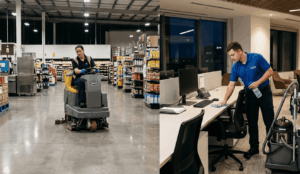
How Specialist Services Fit Into Each Model
Both office and commercial cleaning rely on periodic specialist services, but how they’re planned differs.
Common specialist services include:
- Professional carpet cleaning
- Window cleaning
- Hard floor care
- Deep disinfection or sanitisation
In office environments, these services are usually scheduled periodically to support routine cleaning. In broader commercial environments, they may be core components of the contract.
Which One Does Your Business Actually Need?
To decide whether you need office cleaning or broader commercial cleaning, ask:
- Is the space primarily a workplace with desks and meeting rooms?
- Are hygiene and consistency the main priorities?
- Are specialist environments involved (e.g. childcare, healthcare)?
- Do cleaning requirements change by area within the same site?
If your site includes multiple environment types, you likely need a commercial cleaning approach that includes office cleaning as one component.
Common Problems When the Difference Isn’t Clear
Issues often arise when:
- Businesses book “office cleaning” for non-office areas
- Scope isn’t adjusted for different zones
- Cleaners aren’t trained for specialist environments
- Compliance requirements are overlooked
Clear definitions at the start prevent ongoing scope creep and dissatisfaction.
Step-by-Step: How Professionals Structure Commercial and Office Cleaning
Step 1: Identify environments within the site
Offices, bathrooms, kitchens, reception, storage — each has different needs.
Step 2: Define cleaning standards per environment
Not all areas need the same frequency or detail.
Step 3: Assign tasks by frequency
Daily, weekly, periodic, and specialist work are separated.
Step 4: Schedule specialist services intentionally
Carpet and window cleaning are planned, not reactive.
Step 5: Review and adjust over time
As usage changes, so should the cleaning plan.
This structured approach is typical of experienced commercial cleaning providers, not ad-hoc arrangements.
FAQs: Commercial Cleaning vs Office Cleaning
Is office cleaning the same as commercial cleaning?
Office cleaning is a type of commercial cleaning, but commercial cleaning covers a wider range of environments.
Can an office cleaner clean other commercial spaces?
Only if they’re trained and equipped for those environments. Offices are just one category.
Is commercial cleaning more expensive?
Not necessarily. Pricing depends on scope, frequency, and risk, not the label.
Do all businesses need commercial cleaning?
Any non-residential environment benefits from a commercial cleaning approach, even if office cleaning is the main component.
Why do some cleaners only offer office cleaning?
Because office environments are more predictable than broader commercial settings.
How often should offices be professionally cleaned?
Most offices require multiple cleans per week or daily, depending on staff numbers and usage.
Should specialist services be included or separate?
They’re often scheduled separately to ensure proper time and equipment.
Summary: Commercial Cleaning vs Office Cleaning Explained
- Office cleaning is a subset of commercial cleaning
- Commercial cleaning covers a wider range of environments
- Offices require consistency and repeatability, not just appearance
- Broader commercial sites require adaptable systems and compliance awareness
- Clear scope definitions prevent cleaning gaps and frustration