
Wellington office cleaning services include daily maintenance, deep cleaning, carpet care, window cleaning for high-rise buildings, and specialized sanitization for government, corporate, and professional offices.
Professional cleaners accommodate Wellington’s unique challenges including windy conditions, CBD hill topography, security requirements for government buildings, and after-hours access for the capital’s diverse business community.
Table of Contents
- What’s included in Wellington office cleaning services?
- How much does office cleaning cost in Wellington?
- Why is professional office cleaning essential for Wellington businesses?
- How often should Wellington offices be professionally cleaned?
- What makes Wellington office cleaning unique compared to other NZ cities?
- Do Wellington office cleaners work after hours and weekends?
- How do government and corporate offices in Wellington choose cleaning companies?
- What security and vetting requirements apply to Wellington office cleaners?
- How does professional cleaning improve workplace productivity in Wellington?
What’s included in Wellington office cleaning services?
Professional office cleaning in Wellington provides comprehensive maintenance tailored to the capital’s business environment, from government ministries to private sector offices.
Daily office cleaning tasks:
Reception and public areas:
- Vacuuming all carpeted areas including entrance mats
- Mopping hard floors with commercial-grade cleaners
- Dusting and wiping reception desks and counters
- Cleaning glass doors and entrance windows
- Emptying all rubbish and recycling bins
- Spot-cleaning marks on walls and doors
- Maintaining professional appearance for visitor-facing areas
Individual offices and workstations:
- Vacuuming floors around desks and furniture
- Wiping down desk surfaces and work areas
- Dusting computer equipment exteriors
- Emptying desk bins and organizing waste
- Straightening chairs and tidying visible areas
Kitchen and breakroom maintenance:
- Cleaning and sanitizing sinks and benchtops
- Wiping tables, chairs, and eating surfaces
- Cleaning microwave interiors and exteriors
- Cleaning appliances (kettles, coffee machines, fridges)
- Mopping floors with appropriate cleaners
- Emptying bins and managing recycling
- Restocking supplies (paper towels, hand soap, dishwashing liquid)
Bathroom facilities:
- Cleaning and disinfecting toilets and urinals
- Sanitizing sinks, taps, and mirrors
- Mopping floors with hospital-grade disinfectant
- Restocking toilet paper, soap, and paper towels
- Emptying sanitary disposal units
- Cleaning cubicle doors and partitions
- Wiping fixtures and fittings
Meeting rooms and boardrooms:
- Vacuuming and mopping floors
- Wiping conference tables and chairs
- Cleaning whiteboards and presentation equipment
- Removing used cups, plates, and rubbish
- Arranging furniture if requested
- Ensuring ready-for-use condition
Stairwells and elevators:
- Vacuuming or mopping stairs
- Wiping handrails and banisters
- Cleaning elevator interiors and buttons
- Removing cobwebs and dust
- Ensuring emergency exits remain clear
Weekly deep cleaning services:
Enhanced cleaning tasks:
- Detailed dusting of all horizontal surfaces
- Cleaning interior windows thoroughly
- Sanitizing light switches and door handles
- Vacuuming upholstered furniture
- Cleaning behind and under accessible furniture
- Detailed kitchen deep cleaning
- Cleaning phone handsets and keyboards (if permitted)
Monthly or quarterly specialized services:
Periodic deep cleaning:
- Carpet extraction and deep cleaning
- Hard floor stripping, sealing, and polishing
- External window cleaning (including high-rise)
- High-level dusting (ceiling fans, light fixtures, air vents)
- Blind and curtain cleaning
- Upholstery professional cleaning
- Wall washing and mark removal
Wellington-specific services:
High-rise and CBD building cleaning:
- Multi-floor coordination
- Building management liaison
- Elevator scheduling and access
- Security protocol compliance
- Shared facility cleaning (lobbies, common areas)
Government building cleaning:
- Security clearance requirements
- Sensitive document protocols
- Confidentiality agreements
- Specialized access procedures
- Enhanced vetting standards
Wind and weather management:
- Extra entrance mat cleaning during Wellington’s windy conditions
- Enhanced window cleaning scheduling around weather
- Exterior debris removal after storms
- Water ingress cleaning and prevention
Most commercial cleaning companies in Wellington customize packages based on your specific office type, size, industry, and requirements rather than offering standardized services.
How much does office cleaning cost in Wellington?
Office cleaning costs in Wellington reflect the capital’s specific market conditions, building types, and access requirements.
| Cost Factor | Impact on Pricing |
| Office size | Larger spaces cost more but benefit from economies of scale |
| Cleaning frequency | Daily contracts offer better per-visit rates than weekly |
| Location | CBD hill locations, Lambton Quay, and Thorndon may include access premiums |
| Building complexity | Multi-level buildings or historic properties cost more |
| Security requirements | Government or high-security buildings require vetted staff |
| Parking and access | Limited parking increases costs |
| After-hours requirements | Evening, night, or weekend cleaning may include premiums |
Small office cleaning costs (50-100 square metres):
- Daily cleaning: $75-$140 per visit
- 2-3 times weekly: $95-$170 per visit
- Weekly cleaning: $110-$190 per visit
- Monthly cost (daily service): $1,500-$2,800
Small Wellington offices include professional services practices, startups in co-working spaces, or small branches throughout the CBD and suburbs like Petone, Lower Hutt, or Johnsonville.
Medium office cleaning costs (100-300 square metres):
- Daily cleaning: $140-$330 per visit
- 2-3 times weekly: $170-$380 per visit
- Weekly cleaning: $190-$420 per visit
- Monthly cost (daily service): $2,800-$6,600
Medium offices represent common Wellington business sizes in professional services, government agencies, and corporate branches throughout the Lambton Quay corridor and surrounding business districts.
Large office cleaning costs (300-1000+ square metres):
- Daily cleaning: $330-$950+ per visit
- Per square metre: $0.90-$2.30 per sqm based on frequency and complexity
- Monthly cost (daily service): $6,600-$19,000+
Large offices include government ministry offices, major corporate headquarters in buildings like Majestic Centre or Asteron Centre, and substantial professional services firms.
Additional specialized services:
- Carpet cleaning: $3-$6 per square metre
- Interior window cleaning: $5-$10 per window
- Exterior window cleaning (high-rise): $8-$18 per window depending on height and Wellington wind conditions
- Hard floor maintenance: $4-$7 per square metre for stripping and sealing
- Deep cleaning services: 50-100% premium over standard rates
- One-off cleaning: $450-$1,800+ depending on scope
Wellington-specific pricing factors:
Government building requirements: Offices requiring security-cleared staff, confidentiality agreements, or specialized protocols may incur 10-15% premiums due to additional vetting, training, and compliance costs.
CBD hill geography: Wellington’s steep CBD topography affects parking and access. Buildings on Lambton Quay, The Terrace, or Thorndon hillside require additional time and effort for equipment transport, potentially adding to costs.
Wind and weather contingencies: Wellington’s notorious winds affect exterior cleaning scheduling and sometimes require rescheduling or additional visits, factored into annual costs.
Hutt Valley and Porirua rates: Offices in Lower Hutt, Upper Hutt, or Porirua typically cost 5-10% less than central Wellington CBD due to easier access, parking, and lower operating costs for cleaning companies.
Building age and type: Wellington’s diverse building stock from heritage structures to modern developments requires different approaches. Historic buildings may need specialized care increasing costs slightly.
Contract terms and pricing:
Long-term contracts (12 months) typically offer 15-20% better rates than month-to-month arrangements or casual service.
Multiple location discounts: Businesses with offices across Wellington region may negotiate better rates for consolidated cleaning across sites.
Bundled services: Combining regular cleaning with periodic carpet care, window cleaning, and deep cleaning often provides better overall value than separate contracts.
Most professional Wellington office cleaners provide free on-site assessments, evaluating your specific space, requirements, access challenges, and any unique considerations before providing accurate quotes.
Busy Bees Wellington provides transparent, customized quotes based on your office’s location, size, frequency needs, and any special requirements for government or corporate environments.
Why is professional office cleaning essential for Wellington businesses?
Wellington’s unique characteristics as New Zealand’s capital and government centre create specific needs making professional office cleaning critical for business success.
Government and corporate standards:
Wellington hosts New Zealand’s public service, government ministries, crown entities, and major corporate headquarters. This concentration of professional, high-stakes environments demands exceptional cleanliness standards. Government offices welcoming overseas delegations, ministers, and senior officials require consistently pristine facilities reflecting New Zealand’s professionalism.
Corporate offices serving national functions similarly need environments matching their professional responsibilities. First impressions matter significantly when Wellington offices serve as national headquarters or centres of decision-making.
Regulatory compliance requirements:
Health and Safety at Work Act 2015 mandates safe, hygienic work environments. Wellington employers must provide:
- Clean, sanitary bathroom facilities
- Hygienic kitchen and food preparation areas
- Regular waste removal
- Clean floors preventing accidents
- Adequate air quality and ventilation
WorkSafe New Zealand can prosecute non-compliance. Professional cleaning provides documented evidence of meeting legal obligations.
Building compliance under Building Act 2004 requires maintained premises including:
- Clean emergency exits and fire safety equipment
- Maintained building systems
- Building warrant of fitness compliance
- Regular upkeep preventing deterioration
Wellington City Council enforces these standards through inspections and compliance monitoring.
Wellington’s environmental challenges:
Wind and weather impacts: Wellington’s famously windy conditions create unique cleaning challenges. Wind drives:
- Dust and debris into building entrances
- Salt spray from harbours affecting windows and surfaces
- Rain and moisture through doors and windows
- External debris into reception areas and lobbies
Professional cleaners understand these Wellington-specific factors and implement appropriate solutions like enhanced entrance mat systems, frequent entrance cleaning, and weather-responsive scheduling.
Seismic considerations: Following the Kaikoura earthquake and Wellington’s seismic awareness, building cleanliness includes emergency preparedness. Clean, organized offices facilitate evacuation, and regular cleaning ensures emergency exits remain accessible and visible.
Humidity and coastal climate: Wellington’s maritime climate creates humidity affecting indoor environments. Professional cleaning prevents mold, manages moisture, and maintains healthy indoor air quality particularly in older buildings with less effective ventilation.
Employee wellbeing and productivity:
Wellington’s public sector employs tens of thousands requiring healthy work environments. Professional cleaning significantly impacts:
- Sick leave rates (reduced 20-30% with proper cleaning)
- Employee satisfaction and morale
- Focus and productivity
- Staff retention in competitive labour market
The cost of sick leave and staff turnover far exceeds cleaning investment. Wellington salaries averaging $70,000-90,000 mean each sick day costs $270-$350 in lost productivity.
Security and confidentiality:
Government offices, legal practices, and corporate headquarters handle sensitive information requiring trusted, vetted cleaning staff. Professional cleaning companies provide:
- Police-vetted and security-cleared personnel
- Confidentiality agreements and protocols
- Documented security procedures
- Supervised, accountable teams
DIY cleaning or casual arrangements cannot meet these security standards essential for Wellington’s sensitive business environments.
Professional image maintenance:
Wellington hosts:
- Parliamentary offices and government ministries
- Foreign embassies and diplomatic missions
- Major corporate headquarters
- Leading professional services firms
- National industry associations
These organizations require consistently clean, professional environments reflecting New Zealand’s standards and Wellington’s role as the capital city. Clean offices signal competence, attention to detail, and appropriate investment in operations.
Asset protection in expensive property market:
Wellington’s commercial property values make protecting physical assets financially critical. Professional commercial cleaning extends life of:
- Carpet and flooring installations
- Furniture and fixtures
- Window and glass features
- Paint and interior finishes
- Building systems and equipment
Regular maintenance prevents premature replacement, saving substantial capital costs in Wellington’s expensive property market.
How often should Wellington offices be professionally cleaned?
Cleaning frequency for Wellington offices depends on staff numbers, office type, visitor traffic, and specific business requirements.
Daily professional cleaning suits:
Large offices and government facilities:
- Government ministries and departments
- Large corporate offices (50+ employees)
- Parliamentary and political offices
- High-traffic professional services
- Embassies and diplomatic offices
- Major law firms and consultancies
These high-occupancy, high-stakes environments require daily maintenance to meet professional standards, health requirements, and visitor expectations.
Client-facing professional services:
- Legal practices welcoming clients daily
- Financial services and advisory firms
- Real estate agencies
- Healthcare and medical offices
- Consulting firms with regular client meetings
Daily cleaning ensures consistent professional presentation for clients visiting Wellington offices.
2-3 times weekly cleaning works for:
Medium offices (15-50 employees):
- Professional services firms
- Small government agencies
- Tech companies and startups
- Administrative offices
- Non-profit organizations
These offices generate moderate daily mess but don’t require comprehensive daily cleaning. High-touch surfaces and bathrooms may need daily spot-checks while full cleaning occurs 2-3 times weekly.
Weekly professional cleaning suits:
Small offices (5-15 employees):
- Boutique professional practices
- Small consulting firms
- Branch offices with minimal staff
- Home offices or co-working spaces
Weekly cleaning maintains acceptable standards when staff handle basic daily tidiness between professional services.
Wellington-specific frequency considerations:
CBD vs. suburban offices: Central Wellington CBD offices often need more frequent cleaning due to:
- Higher foot traffic from external visitors
- Greater urban dust and pollution
- Stricter building management standards
- More formal professional expectations
Suburban offices in Lower Hutt, Porirua, or Johnsonville may manage with less frequent cleaning depending on traffic and formality requirements.
Government building standards: Many government offices maintain daily cleaning regardless of size to ensure consistent standards across public service facilities and meet visitor expectations.
Seasonal adjustments for Wellington:
Winter months (May-September): Consider increasing cleaning frequency during Wellington’s wet, windy season when:
- Mud, moisture, and debris tracked indoors dramatically increases
- Cold and flu season requires enhanced sanitization
- Reduced natural ventilation (closed windows) means indoor air quality deteriorates
- Wellington’s rain and wind drive more dirt into buildings
Summer months (December-March): May allow slightly reduced frequency as:
- Better natural ventilation through open windows
- Less moisture and mud tracking
- Holiday periods mean reduced office occupancy
- Wellington’s drier summer weather reduces entrance area soiling
Wind event responses: After particularly strong Wellington wind events, offices may need additional entrance cleaning or immediate response to address wind-driven debris and dust.
Industry and security-specific requirements:
Government and high-security offices typically require daily cleaning with security-cleared staff regardless of office size, maintaining consistent standards and security protocols.
Healthcare offices need daily cleaning minimum to meet infection control standards and Ministry of Health guidelines.
Legal and financial services handling confidential information typically need daily or near-daily cleaning with vetted, trusted staff.
Complementary service scheduling:
Beyond regular cleaning frequency, Wellington offices benefit from:
- Carpet deep cleaning: Quarterly for high-traffic areas, annually for low-traffic spaces
- Window cleaning: Quarterly minimum due to Wellington’s wind and salt spray; monthly for harbour-facing buildings
- Hard floor maintenance: Annually or bi-annually for stripping and sealing
- Deep sanitization: Semi-annually for comprehensive cleaning
Cost-benefit analysis for Wellington offices:
Consider a 35-person Wellington office:
- Weekly cleaning: $190/visit = $9,880 annually
- 3x weekly cleaning: $170/visit = $26,520 annually
- Daily cleaning: $140/visit = $36,400 annually
The additional investment in frequent cleaning returns through:
- Reduced sick leave (20% reduction = $16,000 annual savings based on Wellington salary averages)
- Improved productivity (2% improvement = $49,000 value)
- Better staff retention (preventing one replacement saves $20,000-60,000)
- Extended asset life (delaying carpet replacement saves $15,000-30,000)
For most Wellington offices, appropriate cleaning frequency balances budget with professional standards required for capital city business operations.
What makes Wellington office cleaning unique compared to other NZ cities?
Wellington’s characteristics as New Zealand’s capital create distinct office cleaning requirements compared to Auckland, Christchurch, or regional centres.
Government and political environment:
Wellington hosts New Zealand’s parliament, government ministries, crown entities, and public service headquarters. This concentration creates unique requirements:
Security and vetting standards: Government offices require enhanced security clearances, confidentiality agreements, and strict protocols uncommon in commercial offices elsewhere. Cleaners must understand and comply with Official Information Act considerations, security procedures, and sensitive document handling.
Parliamentary and ministerial offices demand exceptional standards as they host:
- Overseas delegations and diplomatic visitors
- Media and public scrutiny
- High-level government functions
- National decision-making environments
Public service culture emphasizes professionalism, equality, and attention to procedure affecting cleaning service delivery, communication, and expectations.
Geographic and climate challenges:
Wellington’s wind creates cleaning challenges unique in New Zealand:
- Constant debris and dust driven into building entrances
- Enhanced entrance mat and lobby cleaning requirements
- Window cleaning scheduling around wind conditions
- External debris management after storms
- Salt spray from harbours affecting windows and surfaces
Auckland’s urban pollution or Christchurch’s earthquake dust present different challenges, but Wellington’s wind is unmatched nationally.
CBD topography: Wellington’s steep hills create access challenges:
- Difficult parking and equipment transport
- Multi-level buildings on hillsides
- Limited loading zones and service access
- Elevator dependency for high-level buildings
Auckland’s relatively flat CBD or Christchurch’s grid layout offer easier access than Wellington’s vertical terrain.
Harbour and coastal exposure: Buildings near Wellington harbour face salt air and moisture affecting:
- Window cleaning frequency and techniques
- Metal fixture corrosion prevention
- Moisture management and mold prevention
- Exterior cleaning requirements
Seismic awareness: Wellington’s earthquake preparedness affects cleaning approaches:
- Emergency exit visibility and accessibility
- Secure storage of cleaning equipment and chemicals
- Flexible scheduling for seismic events or building evacuations
- Understanding of building evacuation procedures
Post-Kaikoura earthquake awareness remains high in Wellington compared to lower-risk regions.
Building stock characteristics:
Heritage buildings: Wellington CBD includes numerous heritage structures (Government Buildings, Old Government Buildings, historic Lambton Quay properties) requiring:
- Specialized care for historic materials
- Gentle cleaning techniques for aged surfaces
- Preservation-focused approaches
- Understanding of heritage protection requirements
Modern developments: Newer buildings like 1 and 10 Customhouse Quay offer modern systems and materials but different requirements than heritage stock.
Building mix diversity: Wellington’s compressed CBD means cleaners often work in both heritage and modern buildings, requiring versatile skills and knowledge.
Professional services concentration:
Wellington hosts disproportionate concentrations of:
- Legal practices (numerous firms serving government, parliament, courts)
- Policy and consulting firms
- Government relations and lobbying organizations
- National associations and advocacy groups
These professional services demand high cleaning standards reflecting their client-facing, high-stakes work.
Labour market considerations:
Public service employment patterns affect cleaning scheduling:
- Government core hours (typically 8am-5pm) create predictable after-hours access
- Public holiday schedules affect cleaning timing
- Budget cycles influence contract timing and pricing
- Security clearance requirements limit available cleaner pool
Wellington salaries are higher than most regional centres (though lower than Auckland), affecting labour costs for cleaning companies and client expectations.
Transport and logistics:
Limited parking in CBD Wellington creates greater challenges than many regional centres. Cleaning companies must:
- Navigate expensive parking costs
- Schedule around parking availability
- Use smaller, more maneuverable vehicles
- Coordinate with building management for loading access
Compact CBD means many offices are within small geographic area, allowing efficient routing but requiring careful timing to avoid traffic congestion on Golden Mile, Lambton Quay, and Thorndon corridors.
Public transport focus: Wellington’s public transport orientation affects cleaner commuting patterns and scheduling flexibility, though after-hours cleaning occurs when public transport is limited.
Regulatory environment:
Wellington City Council enforcement of building standards, health regulations, and environmental requirements creates specific compliance landscape different from other regions.
Government procurement: Public sector offices must follow government procurement rules, creating formal tender and contract processes uncommon in private sector elsewhere.
Building management concentration: Many Wellington CBD offices operate within buildings managed by large property management firms requiring coordination, compliance, and relationship management at scale.
Despite these Wellington-specific factors, experienced cleaning companies like Busy Bees with over 30 years of New Zealand experience understand regional variations and adapt services appropriately. Wellington office cleaning requires capital city knowledge combined with professional standards delivering results meeting Wellington’s unique demands.
Do Wellington office cleaners work after hours and weekends?
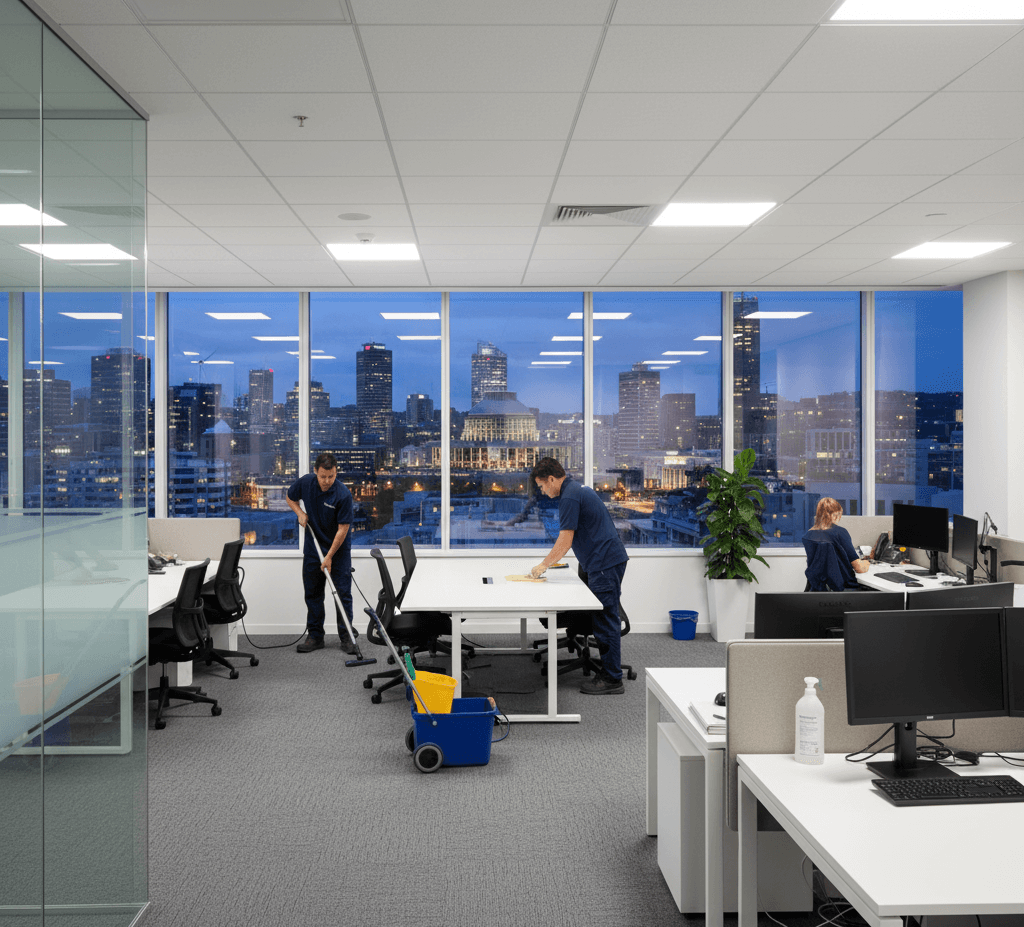
Yes, Wellington office cleaning primarily occurs outside business hours to minimize disruption and accommodate the capital’s working patterns.
Evening cleaning (5:30pm-11pm) is most common:
Advantages for Wellington offices:
- Government and corporate offices empty by 5:30-6pm
- Full access to all spaces without disrupting work
- Parking becomes available and free after 6pm in CBD
- Natural light available early evening
- Equipment and cleaning won’t interfere with operations
- Meeting rooms and offices fully accessible
Ideal for:
- Small to medium offices (5-50 employees)
- Professional services practices
- Government branch offices
- Suburban business offices in Hutt Valley or Porirua
- Non-ministerial offices
Evening cleaning allows thorough, efficient service when Wellington’s business day concludes.
Night cleaning (11pm-6am) suits larger operations:
Advantages:
- Complete building access with no staff present
- Coordination with building security
- Uninterrupted cleaning time
- Minimal parking conflicts
- Comprehensive access to government facilities
Ideal for:
- Large government ministries
- Major corporate headquarters in CBD towers
- Buildings with 100+ total occupants across tenants
- High-security environments requiring specific access times
Challenges of night cleaning:
- Premium rates (10-20% higher than evening)
- Limited night-shift cleaner availability
- Security and building management coordination
- Transport limitations (reduced public transport after midnight)
Many Wellington CBD buildings coordinate night cleaning across multiple tenants, with building management overseeing unified schedules and access.
Weekend cleaning works for specific situations:
Saturday cleaning suits:
- Offices requiring undisturbed deep cleaning time
- Special project cleaning or moves
- Preparation for Monday events or meetings
- Businesses with flexible schedules
Sunday cleaning is less common but available for:
- Emergency cleaning needs
- Event preparation
- Special deep cleaning projects
Challenges:
- Weekend premium rates
- Limited cleaner availability
- Building access if security-controlled
- Parking may be limited in Wellington CBD even on weekends
Daytime cleaning occurs in:
Government ministry offices: Some large government buildings employ dedicated daytime cleaners maintaining high-traffic public areas, reception spaces, and bathroom facilities throughout working hours, supplemented by comprehensive after-hours cleaning.
Healthcare facilities: Medical centres, dental practices, and health providers need continuous cleaning managing patient areas during operating hours.
Parliamentary precinct: Some parliament buildings maintain daytime cleaning presence for public areas, visitor spaces, and high-use facilities.
Access and security for Wellington offices:
Wellington’s government and corporate offices have sophisticated security requiring careful management:
Security clearances: Government offices require cleaners to hold appropriate security clearances, ranging from basic vetting to higher clearances for sensitive environments.
Access cards and swipe systems: Most CBD buildings use electronic access control with cleaners issued time-restricted access cards.
Alarm systems: Cleaners receive alarm codes with sign-in/sign-out protocols creating documented audit trails essential for government security.
Building security coordination: CBD buildings often require cleaners to check in with security personnel, maintaining entry/exit logs.
Confidentiality protocols: Government offices require confidentiality agreements and training on sensitive document handling. Cleaners must understand they cannot read, copy, or discuss documents encountered.
Lockup responsibilities: After-hours cleaners typically bear responsibility for locking offices, setting alarms, and ensuring security, requiring trustworthy, trained staff.
Wellington-specific scheduling considerations:
Government working patterns: Wellington’s public service generally works standard hours (8am-5pm) creating predictable, consistent after-hours access times beneficial for cleaning scheduling.
Parliamentary sitting schedules: When parliament sits, some ministerial and parliamentary offices have extended hours requiring flexible cleaning schedules.
Wind and weather: Wellington’s notorious winds occasionally affect scheduled cleaning:
- Exterior window cleaning rescheduled during high winds
- Additional entrance cleaning needed after storms
- Flexible scheduling to accommodate weather impacts
Transport challenges: Wellington’s limited after-hours public transport affects cleaner availability for very late night shifts. Cleaning companies must consider staff transport when scheduling.
Building management coordination: Many Wellington CBD buildings enforce cleaning windows coordinated across tenants, limiting flexibility but ensuring building-wide efficiency and security management.
Multi-location coordination: Government agencies with offices across multiple Wellington locations often prefer synchronized cleaning schedules, requiring coordination across CBD, Thorndon, and suburban sites.
For businesses concerned about after-hours access and security, professional Wellington cleaning companies provide:
- Police-vetted and security-cleared staff
- Government-approved confidentiality agreements
- Comprehensive insurance coverage
- Documented security procedures
- Regular supervision and quality audits
- Clear key management and access protocols
After-hours cleaning is standard practice across Wellington’s business and government community, balancing operational needs with security requirements and professional cleaning standards.
How do government and corporate offices in Wellington choose cleaning companies?
Wellington’s concentration of government and major corporate offices creates specific selection criteria and processes for choosing cleaning companies.
Government procurement requirements:
Rules of Sourcing compliance: Government offices must follow Government Rules of Sourcing for procurement, including cleaning contracts above certain thresholds (typically $100,000+ across multiple years).
This requires:
- Formal request for proposal (RFP) or tender processes
- Documented evaluation criteria
- Transparent, fair evaluation
- Value-for-money assessment (not solely price)
- Contract management frameworks
All-of-Government contracts: Some government agencies access All-of-Government (AoG) panel arrangements for cleaning services, selecting from pre-approved suppliers meeting government standards.
New Zealand Business Number (NZBN): Government contracts require valid NZBN registration, proper business structure, and tax compliance.
Living Wage considerations: Some government agencies and Wellington City Council commit to Living Wage, requiring cleaning contractors pay Living Wage rates affecting service costs but ensuring ethical employment.
Essential verification and compliance:
Security vetting requirements:
Government offices require cleaning staff to hold:
- Basic police vetting (minimum for most government offices)
- Security clearance for sensitive environments
- Confidentiality agreements and training
- Understanding of Official Information Act obligations
Cleaning companies serving government must maintain systems managing staff vetting, clearance expiry tracking, and replacement of non-cleared staff.
Insurance and financial stability:
Minimum insurance requirements:
- Public liability: $5-10 million for government contracts (higher than commercial sector’s typical $2 million)
- Employer liability covering all staff
- Professional indemnity insurance
- ACC coverage with good claims history
Financial stability assessment: Government agencies evaluate financial stability to ensure contractors can deliver across multi-year contracts without financial failure risk.
Health and Safety compliance:
WorkSafe registration and documentation:
- Health and Safety at Work Act 2015 compliance
- Site-specific safety plans
- Staff training documentation
- Incident reporting procedures
- Emergency response protocols
Government offices conduct safety audits and require safety documentation exceeding typical commercial sector requirements.
Experience and capability assessment:
Relevant experience verification:
Government and corporate offices evaluate:
- Demonstrated experience in government or large corporate environments
- Wellington-specific knowledge and operational history
- Similar-scale contract delivery
- References from comparable clients
- Building type experience (high-rise, heritage, modern)
Staff management and quality systems:
Supervision and quality control:
- Regular supervisor presence and oversight
- Quality audits and inspection documentation
- Client feedback systems
- Performance reporting
- Issue resolution procedures
Staff training programs:
- Cleaning technique certification
- Product safety and handling training
- Security and confidentiality training
- Customer service standards
- Wellington building-specific orientation
Staff retention metrics: High staff turnover signals management problems. Stable teams provide consistency and familiarity with specific Wellington office requirements.
Backup and business continuity:
- Adequate staff numbers for replacement if regulars unavailable
- Emergency response capability
- Business continuity plans
- No single-point-of-failure dependencies
Environmental and sustainability criteria:
Eco-friendly cleaning requirements:
Wellington’s environmental consciousness, particularly in government and progressive corporate sectors, requires:
- Environmentally certified cleaning products
- Green cleaning programs meeting environmental standards
- Waste reduction and recycling practices
- Water conservation approaches
- Compliance with Environmental Protection Authority guidelines
Carbon footprint considerations: Some Wellington organizations evaluate cleaning contractors’ carbon footprints, preferring local operations reducing transport emissions.
Product transparency: Provision of safety data sheets, product ingredient disclosure, and environmental impact information.
Service quality and flexibility:
Responsive communication:
- Easy contact and prompt responses
- Dedicated account management for large contracts
- Regular meetings and service reviews
- Proactive issue identification
- Flexibility for schedule changes or special requests
Wellington-specific understanding:
- Knowledge of Wellington building management requirements
- Understanding government office protocols
- Awareness of parliamentary and ministerial office sensitivities
- Experience with Wellington’s wind, weather, and geographic challenges
Technology and reporting:
- Digital reporting systems
- Online communication platforms
- Performance dashboards
- Issue tracking systems
Value assessment over price:
Government and corporate offices increasingly evaluate value rather than accepting lowest price:
Total cost of ownership includes:
- Service quality and reliability
- Sick leave reductions from better cleaning
- Asset life extension from proper maintenance
- Staff productivity improvements
- Risk mitigation through proper insurance and vetting
Avoiding false economy: The cheapest cleaning often means:
- Inadequate vetting and security risk
- Undertrained staff and poor results
- Insufficient insurance creating liability
- High staff turnover and inconsistency
- Potential labour exploitation
Professional organizations recognize that investing appropriately in cleaning protects larger interests and delivers better long-term value.
Contract structure preferences:
Multi-year contracts (2-5 years) provide:
- Price stability and predictability
- Relationship development
- Consistent service quality
- Value through volume commitment
Performance-based contracts linking payment to quality metrics and client satisfaction.
Trial periods allowing assessment before long-term commitment, though government may need to structure these carefully within procurement rules.
Established cleaning companies like Busy Bees with over 30 years of New Zealand experience understand government procurement, security requirements, and corporate expectations, delivering Wellington office cleaning meeting capital city standards.
What security and vetting requirements apply to Wellington office cleaners?
Wellington’s concentration of government offices, embassies, and corporate headquarters creates stringent security and vetting requirements for cleaning staff accessing these environments.
Police vetting standards:
Basic police vetting represents the minimum for Wellington office cleaning:
- Checks criminal history records
- Identifies convictions for dishonesty, violence, or security-relevant offenses
- Valid 3 years (refresh required)
- Required by most commercial and all government offices
Professional cleaning companies maintain current vetting for all staff, tracking expiry dates and refreshing ahead of time ensuring no lapses.
Security clearances for government offices:
Different clearance levels apply based on office sensitivity:
Baseline vetting: Required for routine government offices, including:
- Criminal history checks
- Identity verification
- Financial probity checks
- Employment and reference checks
Confidential clearance: Required for offices handling confidential information:
- More thorough background investigation
- Financial checks and credit history
- Employment verification with depth
- Character references
Secret clearance: Required for highly sensitive government environments:
- Comprehensive background investigation
- Security service involvement
- Detailed financial and personal checks
- Regular renewal requirements
Cleaning staff accessing ministerial offices, intelligence agencies, defence facilities, or highly sensitive areas require appropriate clearances matching the environment’s classification level.
Clearance processing time: Security clearances take weeks to months, requiring cleaning companies to plan workforce carefully and maintain pools of cleared staff.
Confidentiality agreements and training:
Non-disclosure agreements (NDAs): Government office cleaners sign comprehensive confidentiality agreements covering:
- Information encountered during cleaning
- Documents visible on desks or screens
- Overheard conversations
- Office layouts and security arrangements
- Individual staff presence and activities
Confidentiality training covers:
- Obligations under Official Information Act
- Sensitive document handling (don’t read, move, or touch)
- Secure disposal of visible classified documents if found
- Reporting protocols if documents found unsecured
- Understanding classification markings (Restricted, Confidential, Secret)
Practical protocols for Wellington government offices:
Cleaners must:
- Never read documents visible on desks
- Report any unsecured classified documents to security
- Avoid disrupting closed documents or files
- Never photograph office layouts or documents
- Refrain from discussing office details externally
Access control and monitoring:
Electronic access systems:
Wellington CBD buildings and government offices use sophisticated access control:
- Swipe cards programmed for specific times and areas
- Biometric readers in high-security areas
- Multi-factor authentication for sensitive zones
- Audit trails recording all access events
Security escort requirements: Some government offices require cleaners to be escorted by security or authorized staff, particularly in highly sensitive areas.
CCTV monitoring: Most Wellington CBD buildings and government offices maintain comprehensive CCTV coverage, recording cleaner movements and activities for security verification.
Alarm systems and protocols:
Cleaners receive:
- Unique alarm codes (not shared across staff)
- Sign-in/sign-out requirements
- Duress code training for emergencies
- Regular code changes and updates
Document security protocols:
Clean desk policies in government offices mean:
- Cleaners shouldn’t encounter classified documents
- Any documents visible should be reported
- Cleaners never move or handle paperwork
- Secure bins (cross-cut shredders) used for waste disposal
Screen privacy: Cleaners turn away from computer screens and never attempt to access computers or networks.
Visitor management:
Building security maintains records of:
- Cleaner entry and exit times
- Duration of visits
- Areas accessed
- Equipment brought in/out
- Any incidents or irregularities
Equipment security:
Cleaning equipment stored securely and accounted for:
- No unauthorized items brought into secure areas
- Equipment inspected when entering/leaving
- Tools and supplies tracked preventing unauthorized removal
Staff identification:
Cleaners must:
- Wear visible identification badges
- Carry authorization letters if requested
- Identify themselves to security or staff if questioned
- Report if badges lost or stolen
Mobile device restrictions:
Many government offices prohibit:
- Mobile phones in secure areas
- Cameras and recording devices
- Personal electronic devices
- USB drives or storage media
Professional cleaning companies provide phone-free protocols for staff working in restricted environments.
Incident reporting requirements:
Cleaners must immediately report:
- Unsecured classified documents
- Security concerns or breaches
- Suspicious activity or persons
- Property damage or incidents
- Access issues or system failures
Regular security reviews:
Government offices conduct periodic security reviews including:
- Cleaner performance assessment
- Compliance audits
- Security incident analysis
- Vetting and clearance verification
- Protocol adherence checks
Employment and immigration verification:
Wellington government offices require:
- Valid New Zealand work authorization
- Identity verification meeting Real Me or equivalent standards
- No false identity red flags
- Employment eligibility confirmation
Financial probity checks:
Higher clearances require financial checks ensuring:
- No significant debt making staff vulnerable to coercion
- No bankruptcy or financial distress
- Stable financial circumstances
- No indicators of financial pressure
Corporate sector security:
Private sector Wellington offices, particularly in banking, legal, insurance, or corporate headquarters, similarly require:
- Police vetting as minimum
- Confidentiality agreements
- Access control compliance
- References and employment verification
Legal practices and financial services firms handling sensitive client information need trusted, vetted staff matching government-level requirements.
Professional cleaning companies like Busy Bees maintain robust vetting, security, and compliance systems ensuring staff meet Wellington’s stringent security requirements for commercial cleaning in government, diplomatic, and corporate environments.
How does professional cleaning improve workplace productivity in Wellington?
Professional office cleaning delivers measurable productivity improvements and health benefits for Wellington’s business and government workforce.
Reduced sick leave and illness transmission:
Wellington offices, particularly during winter months (May-September), face significant illness transmission challenges. Open-plan offices common in government departments and corporate environments enable rapid virus spread.
Sanitization impact: Professional cleaning with hospital-grade disinfectants targeting high-touch surfaces significantly reduces illness transmission:
- Door handles and push plates
- Light switches and elevator buttons
- Shared equipment (printers, copiers, coffee machines)
- Meeting room surfaces and chairs
- Bathroom fixtures and taps
- Kitchen benchtops and appliances
Statistics on cleaning effectiveness: Research consistently demonstrates:
- Proper workplace cleaning reduces sick leave by 20-30%
- Enhanced winter sanitization further reduces illness outbreaks
- Touchpoint cleaning programs cut workplace colds and flu by up to 80%
Wellington salary context: With average Wellington public sector salaries around $75,000-85,000, each sick day costs employers $290-330 in lost productivity. For a 40-person office:
- 200 annual sick days (5 per person average)
- Cost: $58,000-66,000 annually
- 20% reduction saves: $11,600-13,200 annually
This saving alone often justifies professional cleaning investment.
Improved air quality and cognitive function:
Wellington’s maritime climate creates humidity requiring proper ventilation management. Office air quality significantly impacts cognitive performance.
Indoor air quality concerns:
Offices accumulate:
- Dust and particulates from Wellington’s wind
- Allergens (pollen, mold spores, dust mites)
- VOCs from furniture, electronics, paint
- Carbon dioxide from occupants in poorly ventilated spaces
- Harbor salt particles in coastal-facing buildings
Cleaning’s air quality impact:
Professional cleaning addresses air quality through:
- Regular carpet deep cleaning removing trapped allergens
- HEPA-filter vacuuming preventing particle redistribution
- Ventilation system maintenance
- Mold prevention and removal
- Use of low-VOC cleaning products
Cognitive performance data: Studies show improved air quality:
- Increases decision-making performance by up to 11%
- Enhances cognitive function including response times
- Reduces headaches, fatigue, and concentration difficulties
- Improves focus and information processing
For Wellington’s knowledge workers in policy, legal, consulting, and government roles, cognitive performance directly impacts work quality and productivity.
Psychological benefits and workplace morale:
Clean environment psychology: Clean, organized workspaces provide psychological benefits:
- Reduced stress and mental clutter
- Improved focus and concentration
- Greater sense of workplace order
- Enhanced pride in work environment
- Signal of employer care for staff wellbeing
Princeton University research demonstrates physical clutter competes for attention, reducing working memory and increasing cognitive load. Professional cleaning eliminates these distractions.
Wellington workplace culture: Public sector and professional service culture in Wellington emphasizes employee wellbeing. Clean offices demonstrate organizational commitment to staff, affecting morale, engagement, and satisfaction.
Meeting and collaboration effectiveness:
Wellington’s government and corporate offices host countless daily meetings for policy development, client consultations, and decision-making.
Clean meeting spaces enhance effectiveness by:
- Creating professional, distraction-free environments
- Avoiding unpleasant odors or mess disrupting focus
- Signaling meeting importance through environment quality
- Ensuring comfort for extended sessions
Client impression impact: Professional services firms, legal practices, and consultancies throughout Wellington’s CBD rely on clean offices for client confidence. Messy environments damage professional credibility affecting business development and client retention.
Absenteeism and presenteeism reduction:
Beyond measurable sick leave, clean offices reduce:
Voluntary absenteeism: Employees in clean, pleasant offices are more likely to:
- Arrive on time rather than delaying entry
- Work from office when hybrid options available
- Remain full workday rather than leaving early
- Engage fully throughout working hours
Presenteeism reduction: Unwell employees attending work (presenteeism) perform 30-50% below capacity. Enhanced cleaning reduces both illness incidence and severity, minimizing productivity loss from staff working while unwell.
Recruitment and retention benefits:
Wellington’s competitive labour market for skilled public sector and private sector roles makes workplace quality a differentiation factor.
Attraction benefits: Clean, well-maintained offices signal:
- Professional, employee-focused organization
- Attention to detail and quality standards
- Investment in workplace environment
- Pride in organizational presentation
Retention impact: Workplace cleanliness contributes to overall job satisfaction affecting retention decisions. In Wellington’s public sector where staff movement between agencies is common, workplace environment influences staying decisions.
Turnover cost context: Replacing skilled Wellington staff costs:
- Recruitment: $5,000-15,000
- Training and onboarding: $10,000-30,000
- Lost productivity during vacancy: $20,000-50,000
- Total: $35,000-95,000 per replacement
Professional cleaning contributing to retention provides massive ROI compared to turnover costs.
Emergency preparedness and business continuity:
Wellington’s seismic awareness makes emergency preparedness critical. Clean, organized offices:
- Facilitate rapid evacuation (clear pathways, visible exits)
- Enable emergency assembly point accounting
- Support business continuity and rapid office restoration
- Maintain building compliance reducing earthquake risk
Post-emergency office restoration requires professional cleaning for:
- Dust and debris removal
- Water damage mitigation
- Contamination cleaning
- Air quality restoration
Productivity measurement in Wellington context:
Consider a 50-person Wellington policy team:
- Sick leave reduction: 25% of $72,500 = $18,125 annual savings
- Cognitive performance: 3% improvement on $3.75M annual salaries = $112,500 value
- Retention benefit: Preventing one replacement saves $50,000+ in turnover costs
- Total benefit: $180,625+ annually
- Cleaning investment: $40,000-50,000 for daily service
- ROI: 360%+ return on cleaning investment
These benefits apply across Wellington’s government, corporate, and professional services sectors.
Implementation for maximum Wellington benefit:
Maximize productivity benefits through:
- Daily professional cleaning for offices 20+ employees
- Enhanced winter sanitization (May-September)
- Focus on touchpoint disinfection
- Regular carpet and air quality maintenance
- Low-VOC, eco-friendly products
- Staff communication about cleaning standards
Professional Wellington office cleaning represents investment in workforce productivity rather than mere operational expense. Wellington employers recognize cleaning’s contribution to organizational performance through healthier, more focused, more satisfied employees delivering higher-quality work in New Zealand’s capital.
Conclusion: Key Takeaways on Wellington Office Cleaning
Professional office cleaning provides essential support for Wellington’s government, corporate, and professional services sectors:
- Comprehensive Wellington cleaning includes daily maintenance, deep cleaning, and specialized services for government buildings, CBD high-rises, and professional offices, accommodating capital city security and access requirements
- Wellington office cleaning costs range from $75-$140 daily for small offices to $330-$950+ for large spaces, with government building and high-security environments potentially incurring 10-15% premiums for enhanced vetting and protocols
- Cleaning frequency should be daily for large offices, government facilities, and client-facing practices, 2-3 times weekly for medium offices, and weekly for small offices, with winter increases during Wellington’s wet, windy season
- Wellington-specific challenges include government security requirements, windy weather impacts, CBD hill topography, seismic preparedness, heritage building care, and confidential environment protocols
- After-hours cleaning is standard with evening shifts (5:30pm-11pm) common for most offices and night shifts (11pm-6am) for large government and corporate operations requiring security coordination
- Government and corporate selection requires security vetting, enhanced insurance ($5-10 million public liability), government procurement compliance, confidentiality agreements, and value assessment beyond price
- Security requirements include police vetting minimum, security clearances for government offices, confidentiality training, access control compliance, and sensitive document protocols
- Productivity benefits include 20-30% sick leave reduction ($18,000+ annual savings for 50-person office), cognitive performance improvements (up to 11%), enhanced morale, better retention, and 360%+ ROI through measurable workforce benefits
Busy Bees has provided Wellington office cleaning services for over 30 years, understanding the unique requirements of New Zealand’s capital including government security protocols, CBD access challenges, wind and weather management, and the professional standards expected in parliamentary, government, and corporate environments.
Whether you operate a small professional practice, a government branch office, or a major corporate headquarters in Wellington’s CBD, professional office cleaning protects your organization, supports employee health and productivity, and maintains the professional environment appropriate for New Zealand’s capital city operations.
Ready to enhance your Wellington office environment? Contact Busy Bees Wellington for a free assessment and customized quote, or explore our Wellington services to learn more about our commercial cleaning solutions for capital city businesses.