
Residential and commercial cleaning in Auckland differ primarily in standards, structure, accountability, and expectations, not just property size. Choosing the wrong type of cleaning service often leads to missed areas, inconsistent results, and frustration — especially for offices and shared spaces.
While both involve cleaning, the way the work is planned, delivered, and measured changes significantly depending on how a space is used.
Why This Difference Matters in Auckland
Auckland has one of the widest mixes of property types in New Zealand, including:
- High-density apartments
- Standalone homes
- Corporate offices
- Medical, education, and childcare facilities
- Retail and mixed-use buildings
Each environment has different hygiene expectations, access requirements, and risk considerations. This is why many organisations choose providers that specialise in commercial cleaning services rather than relying on cleaners whose experience is limited to domestic work.
What Is Residential Cleaning Designed For?
Residential cleaning is focused on comfort, flexibility, and personal preference.
It typically applies to:
- Houses
- Apartments and units
- Owner-occupied or rental properties
Common characteristics of residential cleaning include:
- Flexible scheduling during the day
- Custom preferences from homeowners or tenants
- Cleaning standards based on personal expectations
- Less formal documentation or reporting
Services such as home cleaning are designed to fit around the way people live, rather than how businesses operate.
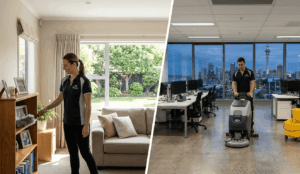
What Is Commercial Cleaning Designed For?
Commercial cleaning is built around consistency, repeatability, and compliance.
It applies to:
- Offices and corporate buildings
- Retail spaces
- Education and childcare facilities
- Healthcare and professional environments
Commercial cleaning typically involves:
- Fixed schedules (often after hours)
- Documented scopes of work
- Trained teams familiar with commercial standards
- Clear accountability and quality control
Businesses operating in Auckland often require cleaning that supports health and safety obligations, staff wellbeing, and professional presentation — not just appearance.
Key Differences Between Residential and Commercial Cleaning
| Area | Residential Cleaning | Commercial Cleaning |
|---|---|---|
| Primary goal | Comfort and appearance | Consistency and hygiene |
| Scheduling | Flexible, daytime | Fixed, often after hours |
| Standards | Personal preference | Documented and repeatable |
| Access | Homeowner present | Keys, alarms, security systems |
| Accountability | Informal feedback | Formal follow-up processes |
These differences explain why a cleaner who performs well in homes may struggle in an office environment without the right systems in place.
Why Offices Can’t Be Treated Like Large Houses
One of the most common mistakes businesses make is assuming office cleaning is simply “house cleaning on a larger scale.”
In reality, offices involve:
- Shared desks and workstations
- High-touch surfaces used by multiple people
- Bathrooms with higher traffic
- Kitchens used by entire teams
- Compliance and presentation expectations
This is why office and commercial cleaning requires a different approach to training, scheduling, and quality control.
Can One Cleaning Company Do Both Residential and Commercial Well?
Yes — but only if they operate separate systems for each type of work.
Established providers of professional cleaning services in Auckland typically:
- Train staff specifically for commercial environments
- Use different checklists and scopes
- Schedule residential and commercial jobs separately
- Apply different quality assurance processes
Without these distinctions, service quality often suffers.
How Pricing and Scope Usually Differ
While exact pricing varies, the structure differs noticeably.
Residential cleaning:
- Often based on time and scope
- Can vary significantly for one-off or deep cleans
- Is influenced heavily by property condition
Commercial cleaning:
- Is often contracted and scheduled
- Becomes more predictable over time
- Is priced around frequency, access, and consistency
This structural difference is why commercial cleaning agreements tend to be more stable once established.
How to Decide Which Type of Cleaning You Need
Ask yourself:
- Is the space shared by multiple people?
- Does it need to meet workplace hygiene standards?
- Is consistency more important than flexibility?
- Is after-hours access required?
If the answer to most of these is “yes,” commercial cleaning is usually the right fit. For personal living spaces, residential cleaning is often more appropriate.
Frequently Asked Questions
Can residential cleaners clean offices?
Some can, but without commercial systems in place, results are often inconsistent.
Is commercial cleaning more expensive?
Not always. Commercial cleaning can be more efficient over time due to routine scheduling.
Do commercial cleaners work after hours?
Yes. After-hours cleaning is standard for many offices and workplaces.
Can the same company clean my home and office?
Yes, provided they have separate processes for residential and commercial work.
Summary: Residential vs Commercial Cleaning in Auckland
- The real difference is standards, structure, and accountability
- Residential cleaning focuses on comfort and flexibility
- Commercial cleaning prioritises consistency and hygiene
- Offices should not be treated like large houses
- The right choice depends on how the space is used